
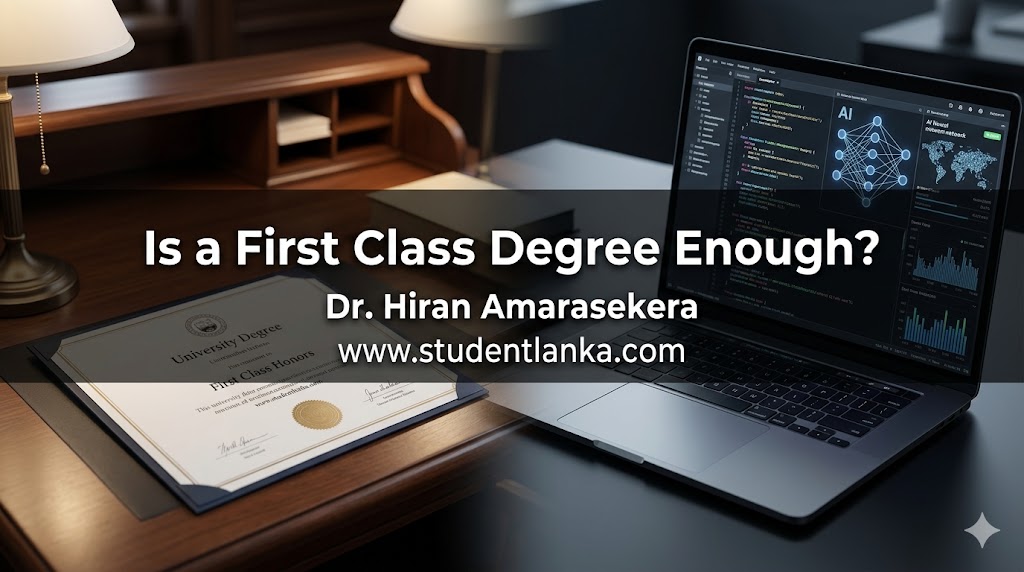
The dream has been passed down for generations in Sri Lankan households: score a high Z-score, enter a top national or private university, secure a First Class or high GPA, pack your bags for a Western MSc, and walk a smooth, guaranteed path to Permanent Residency (PR) and a stable life.
For decades, this was a bulletproof pipeline. But as we move through 2026, thousands of highly qualified Sri Lankan graduates are landing in countries like the UK, Canada, and Australia only to face a harsh, unexpected reality: chronic underemployment, tightening immigration laws, and a job market that no longer rewards paper qualifications alone.
If you are currently studying for a degree or planning your migration strategy, it is time to look at the data. The old formula is broken. Here is what is actually required to settle abroad today.
The Shift in Global Graduate Employability
To understand why a First Class degree is no longer a golden passport, we must look at how the global job market has shifted over the last few years. The currency of the global economy has fundamentally changed.
| Evaluation Metric | The Old Formula (Pre-2020) | The New Reality (2026 & Beyond) |
| Primary Academic Currency | First Class Honors, High GPA, Institutional Names | Verifiable Portfolios, GitHub Repositories, Live Projects |
| Market Condition | Competitive but predictable local/regional talent pools | Mass Global Degree Inflation (Mass supply of graduates) |
| Technological Era | Human-managed basic cognitive and analytical tasks | Proliferation of Agentic AI and Autonomous Workflows |
| Immigration Landscape | Welcoming post-study work tracks; accessible PR routes | Strict Visa Caps, Financial Thresholds, Restricted Dependents |
| Employment Metric | Credentials on paper (What you studied) | Immediate functional capability (What you can build/automate) |
3 Reasons Your First Class Degree Won’t Save You
This paradigm shift isn’t accidental. It is driven by three massive structural changes happening globally right now.
1. Global Degree Inflation
A degree used to be a rare differentiator. Today, with the explosion of private universities, local non-state campuses, and online degree-completion programs across Sri Lanka and the world, degrees are a mass-commodity. When an employer in London or Melbourne posts an entry-level job opening, they receive thousands of applications from individuals who all have a First Class or a high GPA. When everyone has a distinction, a distinction is worth zero.
We are seeing a tragic trend where brilliant Sri Lankan science, IT, and engineering graduates move abroad only to get stuck in survival jobs or severely underemployed roles because their academic certificate cannot cut through the noise of a saturated market.
2. Ruthless Cross-Border Competition
When you step out of a classroom in Colombo, Peradeniya, or Sri Jayewardenepura, you are no longer competing with your batchmates. You are entering a global arena. You are competing directly against hyper-aggressive, experienced talent pools from India, China, the Philippines, and Eastern Europe.
Many of these competing graduates do not just have degrees; they enter the job market with two to three years of remote work experience, specialized tech stacks, and global networks. If your only leverage is a 4.0 GPA on a piece of paper, you are inherently disadvantaged.
3. The Agentic AI Revolution
This is the ultimate game-changer. Over the last year, artificial intelligence has evolved from basic chat assistants like ChatGPT and Claude into Agentic AI—autonomous systems that can execute multi-step workflows, write complex software, manage databases, and handle digital marketing funnels with minimal human intervention.
Traditional white-collar entry-level jobs—the exact roles corporate graduates used to occupy while climbing the ladder abroad—are being aggressively automated. AI will not replace humans, but a professional with advanced AI literacy will completely replace a graduate who only knows traditional textbook theory.
[Traditional Higher Education] ──> Focuses on: Memorization & Theory
                                            │
                                            ▼
                                 [Targeted for AI Automation]
The StudentLanka Blueprint: Future-Proofing Your Strategy
Does this mean you shouldn’t get a degree? Absolutely not. Your degree is still valuable, but you must understand its true function: Your degree is no longer the destination; it is simply the key that opens the entry door. What you carry through that door is what decides your survival.
To future-proof your career and ensure you can actually settle abroad, you must adjust your strategy immediately:
- Prioritize Skills Over Grades: A “Second Class Lower” graduate with a portfolio of real-world projects and a functional GitHub or design portfolio will consistently beat a “First Class” graduate with a blank resume.
- Build AI Fluency Within Your Domain: Whether you are in Biology, Management, Accounting, or Civil Engineering, you must master the AI tools specific to your industry. Learn how to prompt, build workflows, and orchestrate AI agents to do your job five times faster.
- Gain Local Experience Before Migrating: Moving abroad immediately after your Bachelor’s degree with zero work experience is highly risky. Gaining a year or two of gritty, real-world experience in Sri Lanka gives you a massive advantage when applying for professional roles overseas.
The future does not belong to the student who memorized the most content to ace an exam. The future belongs to the adaptive hustler who can look at a changing global landscape, learn new tools at lightning speed, and bring immediate, practical value to an employer.



Leave a Reply