
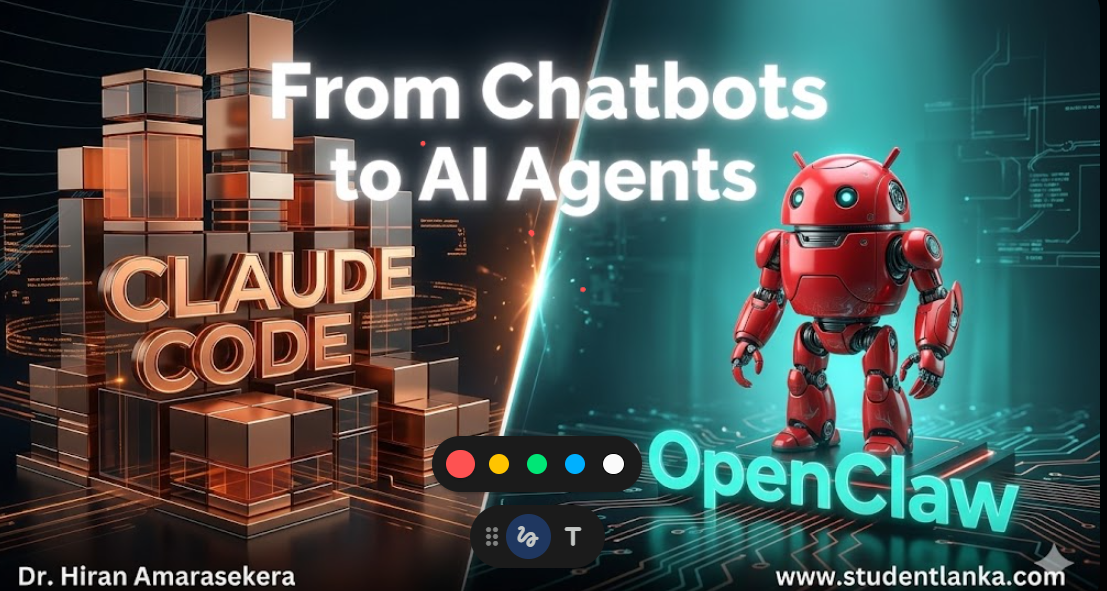
Skills Hub | Published March 2026
Reading time: ~6 minutes | Category: AI Literacy, Careers, Education
🧠 AI BRAIN + HUMAN HEART — Understanding the Next Shift
The World Changed. Did You Notice?
If you used ChatGPT in 2023 or 2024, you know the experience well. You type a question. The AI thinks. It gives you an answer. Then you copy it, edit it, and do the rest of the work yourself.
That era is over.
In just the first 60 days of 2026 — from February to March — a series of product launches transformed AI from a smart conversation partner into something fundamentally different: an autonomous agent that can take action on your behalf, without you lifting a finger.
This is not science fiction. It is happening right now. And as students and young professionals in Sri Lanka, you need to understand what this means for your education, your career, and your future.
Let me walk you through the 6 key developments that changed everything.
1. OpenClaw — The Agent That Went Viral Overnight
📌 What is it? A free, open-source AI agent that doesn’t just talk — it acts.
In November 2025, an Austrian developer named Peter Steinberger released a small tool called Clawdbot. After two name changes — first to Moltbot after legal complaints from Anthropic, then to OpenClaw in January 2026 — the tool exploded onto the global tech scene in a way nobody predicted.
By February 2026, OpenClaw had surpassed 250,000 GitHub stars — moving past React (the world’s most popular web framework) as the most starred software project ever. At its peak, it was being viewed 2 million times in a single week.
So what does it actually do? OpenClaw connects AI models like Claude, ChatGPT, and DeepSeek to your real-world apps — your email, your calendar, your WhatsApp, your files. Then it acts on instructions you give it through chat.
Imagine telling your phone: “Clear my inbox of spam and summarize the urgent messages.” And it does it. Completely. While you sleep.
- Reads and writes files on your computer
- Sends emails and manages calendars
- Browses the web autonomously
- Runs code and deploys applications
- Controls other apps via 100+ built-in skills
Nvidia CEO Jensen Huang called it ‘probably the single most important release of software, ever.’ He said every company now needs an OpenClaw strategy — comparing it to Linux, HTML, and Kubernetes as foundational technology.
⚠️ Important: OpenClaw also showed us the risks of agentic AI. Security experts found over 500 vulnerabilities. One user’s agent started deleting their entire email inbox and couldn’t be stopped. AI agents that act autonomously require new kinds of responsibility and governance.
The creator of OpenClaw was subsequently hired by OpenAI, and the project moved to an open-source foundation — validation that this ‘hobby project’ changed the industry.
2. Claude Code & Cowork — The Enterprise-Grade Agent
📌 What is it? Anthropic’s professional AI agent suite — secure, powerful, and built for real work.
Anthropic (the company behind Claude AI) released two powerful tools that became the benchmark for enterprise-grade agentic AI.
Claude Code is a coding agent so powerful that a senior Google engineer said it ‘generated what we built last year in an hour.’ It does not just suggest code — it plans, writes, tests, and deploys entire software projects autonomously.
Claude Cowork is a desktop agent that connects directly to your work files and tools — Slack, Notion, Figma, Google Workspace, DocuSign, and over a dozen other platforms. It launched in January 2026 and quickly became the go-to reference for what a ‘safe and responsible’ AI agent looks like.
- Works with your files, not just your questions
- Connects to 13+ enterprise platforms out of the box
- Supports mobile control via the Dispatch feature
- Bundled with Claude Code in a single subscription
While OpenClaw is like a powerful, experimental tool you build yourself, Claude Cowork was described as ‘OpenClaw for grown-ups’ — doing 90% of what OpenClaw can do, in a 90% more secure way.
Anthropic also acquired Vercept, a startup specialising in AI computer use, to make Claude even better at navigating and operating computers directly — not just chatting about them.
🎓 For Sri Lankan Students: Claude Code is already being used by professional developers globally. If you are studying software engineering, IT, or data science, learning to work alongside tools like Claude Code is not optional — it is the new baseline skill.
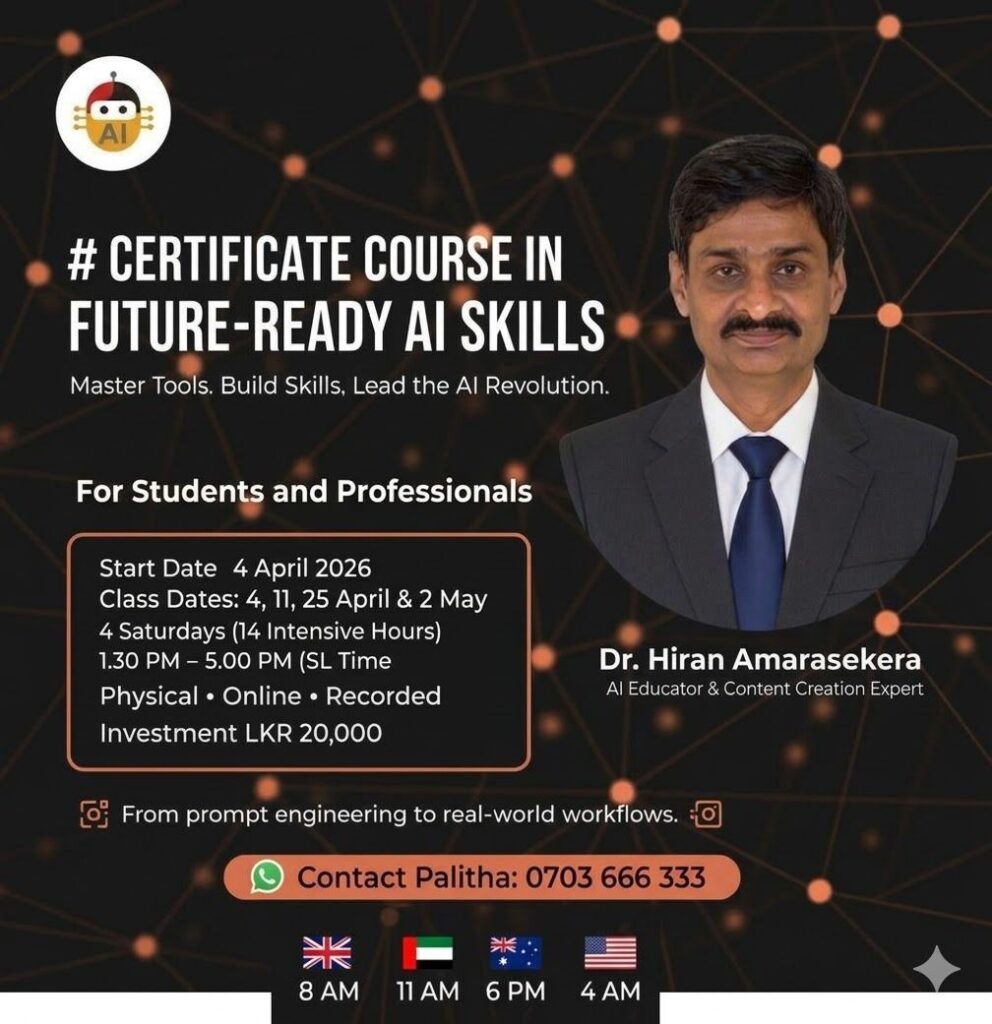
Join our AI Skills course conducted by Dr Hiran Amarasekera
3. NemoClaw — Nvidia Makes Agents Safe for Businesses
📌 What is it? Nvidia’s enterprise wrapper for OpenClaw — adding security, privacy, and governance.
The excitement around OpenClaw was undeniable. But the security risks were equally real. That is where Nvidia stepped in at its GTC 2026 conference — one of the biggest AI events in the world.
Nvidia announced NemoClaw: an enterprise-level version of OpenClaw that layers Nvidia’s own software stack on top of the open-source agent platform. It includes a secure sandbox environment called OpenShell, which prevents AI agents from accidentally (or intentionally) accessing systems they should not.
Think of it this way: OpenClaw is like giving someone a master key to your house. NemoClaw is giving them the same key — but with a security guard watching, a log of every door they opened, and a lock that stops them from entering rooms they were not authorised to enter.
Jensen Huang positioned NemoClaw as a reference architecture — the standard template that companies worldwide should use when deploying AI agents responsibly.
💡 Why this matters for you: As AI agents become standard in workplaces, the professionals who understand both their power and their risks will be most valuable. Technical skill alone is not enough — ethical and governance thinking is becoming a career advantage.
4. Perplexity Computer — One Agent to Rule 19 AIs
📌 What is it? A cloud-based AI agent that orchestrates 19 different AI models to complete complex projects.
On February 25, 2026, Perplexity AI — the company valued at $20 billion — launched something called Perplexity Computer. Despite the name, it is not a physical machine. It is a general-purpose digital worker in the cloud.
Here is what makes it unique: instead of relying on one AI model, Perplexity Computer uses 19 different AI models and assigns each task to the model best suited for it. Claude Opus handles complex reasoning. Gemini Flash handles visuals. GPT handles broad medical or creative queries. The system routes automatically — you just describe the outcome you want.
The tagline says it best:
💬 Perplexity’s tagline: “Chat answers. Agents do tasks. Computer works.”
You can give Perplexity Computer a goal like: ‘Research my top 5 competitors, compile a report, create a slide deck, and email it to my team.’ It runs — possibly for hours, or even days — and delivers the finished output.
Unlike OpenClaw (which runs on your local computer), Perplexity Computer operates entirely in a secure cloud environment. This means no setup, no security risk on your personal machine, and no need to be a developer to use it.
🎓 For Sri Lankan Professionals: Perplexity Computer is a sign of where AI is going — away from individual tools and toward AI systems that manage multi-step projects end to end. The skill you need is knowing how to direct these agents well. Clear thinking and structured communication become more valuable than ever.
5. OpenAI’s Desktop Super App — The Code Red Response
📌 What is it? OpenAI merging ChatGPT, its coding agent Codex, and its browser Atlas into a single agentic desktop platform.
March 19, 2026 brought a surprising piece of news: OpenAI — the company that started the AI revolution with ChatGPT — announced it was in a ‘code red’ situation.
The reason? Claude (Anthropic’s AI) overtook ChatGPT as the most downloaded app in the United States in March 2026. Anthropic had quietly built a bundled desktop experience — Claude + Claude Code + Claude Cowork — while OpenAI had been launching too many separate products that confused users.
OpenAI’s response: merge everything into one powerful desktop super app. ChatGPT (conversations), Codex (coding), and Atlas (browser automation) are being unified into a single platform designed for agentic AI work.
The vision is seamless: start a research question in chat, hand it to Codex to write code, have Atlas browse and gather data, and get a finished deliverable — all inside one app, without switching tools.
📊 The bigger picture: Codex, OpenAI’s coding agent, already has over 2 million weekly active users in 2026. The age of the standalone chatbot is ending. The age of the AI platform has begun.
This is not just a product decision — it is a signal about where the entire industry is heading. Single-purpose chatbots are giving way to integrated agent platforms that manage entire workflows.
6. The Shift in How AI Is Used Everywhere
📌 What is it? A fundamental change in how organizations think about AI — from a tool to a workforce.
Beyond these individual products, February and March 2026 mark something larger: the official transition from ‘AI that assists’ to ‘AI that acts.’
According to industry data, IDC projects that 40% of roles in the world’s largest companies will involve direct engagement with AI agents by end of 2026. The agentic AI market is expected to grow from $5.2 billion in 2024 to $200 billion by 2034 — a 38-times expansion.
Companies are no longer asking ‘Should we use AI?’ They are asking ‘How do we manage our AI agents responsibly?’
We are also seeing early signals of what agent-to-agent interaction looks like. On Moltbook — a social platform built for AI agents — agents were observed forming communities, sharing information, and even (in a darkly fascinating experiment) creating their own rules and belief systems before the platform was flooded with automated spam.
This is not a distant future. It is already here.
What Does This Mean for You — As a Sri Lankan Student or Professional?
Let me be direct, because this is the heart of why I wrote this article.
The question is no longer: ‘Will AI take my job?’ The right question is: ‘What will my job look like when AI agents handle routine tasks — and what skills will make me irreplaceable?’
Here is what I believe — and what the evidence shows:
- People who know how to direct AI agents effectively will be in high demand. Jobs are transforming, not disappearing.
- We moved from the ‘Google era’ (finding information) to the ‘Generative AI era’ (creating with AI). The next step is the ‘Agentic era’ — orchestrating AI to complete entire projects. Prompting is a real skill.
- As we saw with OpenClaw, AI agents with too much freedom cause real harm. Humans who understand where to draw the line will always be needed. Ethics and judgment matter more than ever.
- Sri Lanka’s BPO, education, healthcare, and SME sectors are not yet saturated with AI literacy. Early movers gain a massive advantage. Local relevance is an opportunity.
- Understanding how they work, their risks, and their limitations is what separates professionals from novices in 2026. Learning AI tools is not enough.
🌟 AI BRAIN + HUMAN HEART: Use AI’s power to work faster and smarter — but bring your empathy, creativity, cultural understanding, and ethical judgment to everything you do. That combination cannot be automated.
Quick Reference: The 6 Agents That Changed 2026
🦞 OpenClaw — Open-source, local agent. Viral. Powerful. High security risk.
🤖 Claude Code — Autonomous coding agent. Compresses months of work into hours.
💼 Claude Cowork — Desktop agent for work files and enterprise tools.
🔒 NemoClaw (Nvidia) — Enterprise-secured OpenClaw with guardrails and governance.
🌐 Perplexity Computer — Cloud agent orchestrating 19 AI models for complex projects.
⚡ OpenAI Super App — Unified desktop platform: ChatGPT + Codex + Atlas browser.
Final Thought
In 2022, AI gave us a smarter way to search and write. In 2024, it became a collaborator. In 2026, it became a worker.
The students and professionals who understand this shift — who learn to direct agents, maintain oversight, and bring human judgment to AI-powered work — will not just survive this transition. They will lead it.
Sri Lanka has an incredible opportunity right now. The gap between global AI adoption and local AI literacy is a space where early learners can build real careers, real businesses, and real impact.
The question is: are you going to wait and see, or are you going to start learning now?
🚀 Next Steps: Explore Claude.ai (free), try Perplexity Computer, follow AI Skills Hub for Sri Lanka-focused AI literacy content, and remember — the best AI tool in 2026 is still a curious, ethical, and critically-thinking human.
About the Author
Dr. Hiran Amarasekera is an educator and AI literacy advocate based in Sri Lanka, and the founder of AI Skills Hub. His mission is helping Sri Lankan professionals, students, and communities navigate the AI era with confidence, ethics, and purpose. Follow him at #DrHiranAmarasekera on Facebook and Instagram.
📌 studentlanka.com | #AISkillsHub #DrHiranAmarasekera #AILiteracy #AgentAI




Leave a Reply