
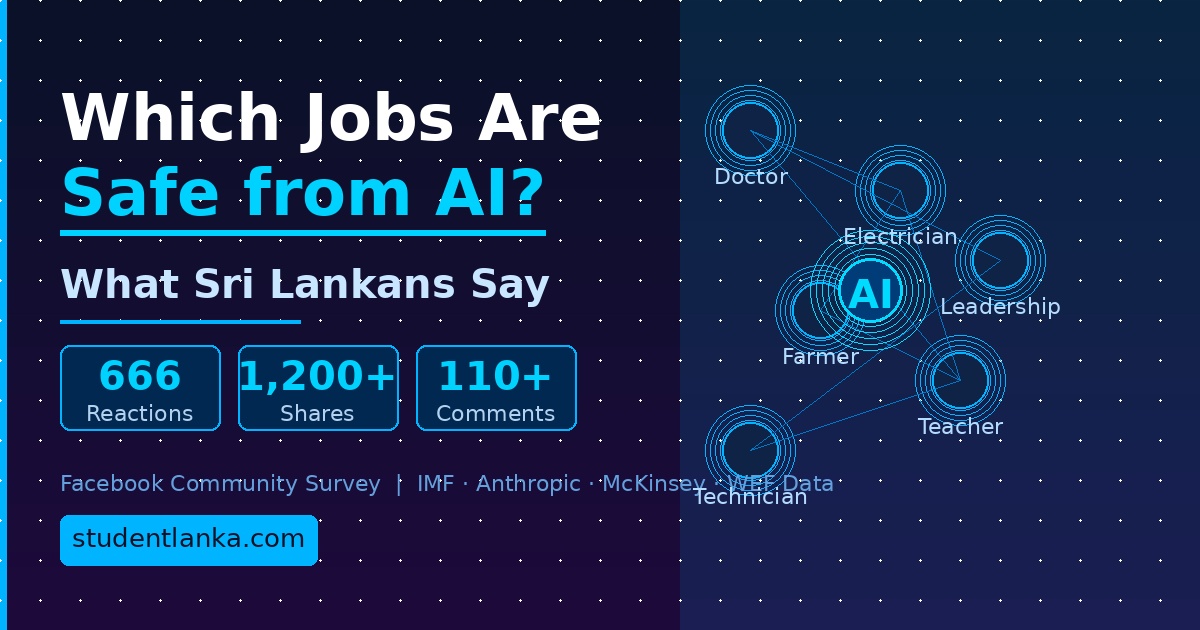
A few days ago (12 Aug 2026), I posted a simple question on Facebook: “AI නිසා නැති නොවන රැකියා මොනවාද? Which jobs are SAFE from AI?”
The response was remarkable. Over 110 comments, 666 reactions, and more than 1,200 shares later, it is clear that this question is on every Sri Lankan’s mind — students, graduates, working professionals, and academics alike.
Here is what the Sri Lankan community said, and how it compares with what global research actually shows.
What Sri Lankans Said
The answers from my Facebook audience covered a wide range — some serious, some humorous, and many surprisingly insightful.
1. Healthcare Tops the List
The most common answer was healthcare. Doctors, dentists, Ayurveda practitioners, nurses, pharmacists, psychologists, and paramedics were all mentioned repeatedly. One comment — “Doctor can’t be replaced by AI” — received 86 likes and sparked 19 replies of debate. The consensus: the human relationship between a patient and a doctor, built on trust, empathy, and physical judgment, is something AI cannot fully replicate.
2. Skilled Trades and Manual Work
Electricians, mechanics, welders, masons, and carpenters came up again and again. The reasoning is straightforward: AI works in the digital world. A burst pipe, a faulty circuit, or a cracked wall still needs human hands in the physical world. These trades are not glamorous, but they are future-proof.
3. Farming
Several commenters named farming as the most resilient occupation of all. One person said it is the “only” truly safe job. Agriculture’s dependence on seasons, soil conditions, local knowledge, and physical labour makes it harder to automate than most people expect.
4. Teaching and Education
Lecturing, early childhood education, and special needs teaching appeared frequently. One commenter made a sharp point: “Teaching How to Use AI” may itself become one of the most important jobs of the next decade.
5. Human Leadership
Several commenters listed politicians and leaders as safe from AI — and there is something important in this. Human leadership, the ability to inspire, to make ethical decisions under pressure, to be accountable to a community, and to navigate complex social dynamics, is genuinely something AI cannot perform. Governance, community leadership, and institutional decision-making all require a human at the centre. That will remain true for a very long time.
6. The Funniest Answer Got the Most Likes
The single most liked comment, with 93 likes, was: “අස්වැසුම හිමිකම” (welfare entitlement). It was a joke, but it landed. Other humorous entries included “Breathing,” “Crossing Diyawanna,” and “Coconut picking.” This tells us something good: the audience is engaged, relaxed, and thinking.
7. The Most Thoughtful Comment
Dasun Nilanjana Sirimevan wrote what may be the most insightful comment in the thread: the real question is not which job title survives, but which human qualities survive. Integrity, empathy, critical thinking, creativity, and patience — these are qualities already rare, and they will become even more valuable as AI takes over repetitive tasks.
Which Jobs Are SAFE FROM AI? What Sri Lankans Say
On 12 August 2026, this question was posted on Facebook to the Sri Lankan community. The response was striking: 666 reactions, over 1,200 shares, and 110+ comments in Sinhala and English — a rare window into public thinking on AI and employment.
- Doctors, nurses, and specialists (high-trust, hands-on)
- Electricians, mechanics, and tradespeople
- Farmers and agricultural workers
- Teachers of young children and special needs
- Counsellors, social workers, caregivers
- Religious and cultural custodians
- Software developers and programmers
- Data analysts and report writers
- Paralegals and junior lawyers
- Accountants and financial analysts
- Content writers and copywriters
- Administrative and back-office roles
What the Global Research Shows
Now let us compare the local conversation with what leading global authorities are finding.
The IMF and WEF Numbers
The International Monetary Fund (IMF) estimates that 40% of jobs worldwide face potential AI exposure. In advanced economies, that figure rises to 60%. For lower-income countries like Sri Lanka, it currently sits around 26% — but this gap is narrowing quickly as AI tools become more accessible.
The World Economic Forum (WEF) projects that by 2030, approximately 300 million jobs may be displaced globally — but 350 million new roles are expected to emerge, a net gain of 50 million positions. This is transformation, not just loss.
Anthropic’s Research: White-Collar Jobs at Most Risk
Anthropic, one of the world’s leading AI research companies, published findings based on a study of 81,000 users. Their research identified computer programmers, customer service representatives, and data entry workers as the occupations most exposed to AI displacement.
Critically, Anthropic found that “computer and math workers” face theoretical AI coverage of 94% of their tasks — though current adoption is only at 33%. The gap is closing fast.
Anthropic also noted that the workers most at risk tend to be educated professionals — not factory or manual workers. They are 16 percentage points more likely to be female, earn 47% higher salaries, and are nearly four times as likely to hold graduate degrees. This means lawyers, financial analysts, and software developers face more disruption in the near term than electricians or farmers.
McKinsey: Most Jobs Will Change, Not Disappear
McKinsey’s research found that 60% of current job roles will experience significant task changes due to AI, and up to 30% of US jobs could be automated by 2030. But the key word is “change,” not “vanish.” AI engineer roles have surged by 143% year on year in demand, with a median salary of USD 157,000 in 2025.
Jobs Most at Risk Globally
According to global data, the highest-risk roles are: Data entry (95% automation risk), Customer service representatives (80%), Retail cashiers (65%), and Transportation and logistics (1.5 million US jobs at risk by 2030).
Sri Lanka vs. Global Research: How Do We Compare?
The good news: Sri Lankan instincts are largely correct. Healthcare, skilled trades, farming, and education were top answers locally — and global research agrees all four are resilient sectors.
Where local and global thinking diverge is in IT and software. Several commenters felt software engineering and IT jobs are safe. Global research shows the opposite: computer and mathematical roles face among the highest AI exposure of any field. This is an important gap in awareness, especially for students choosing technology careers.
The humour in the local answers — welfare recipients, politicians, “breathing” — also signals something real: the Sri Lankan public is aware that AI disruption is not just an IT story. It touches everything.
The Honest Advice for Students
If you are a student in Sri Lanka right now, here is what the evidence says.
Do not pick a career based on what feels safe from AI today. The jobs most affected globally — data entry, customer service, clerical administration — are often the entry-level roles that students target first. These are exactly the roles shrinking fastest.
Instead, build skills that are genuinely harder to automate: human judgment, emotional intelligence, physical skill, creative problem-solving, and the ability to work with people in complex and unpredictable situations.
And learn to use AI tools well. Because in almost every field, the professional who works alongside AI will outperform the one who does not. As one commenter put it: “Stop worrying and start adapting.”
The future belongs to those who do exactly that.
What do you think? Which job do you believe AI will never replace? Share your answer in the comments below.




Leave a Reply