
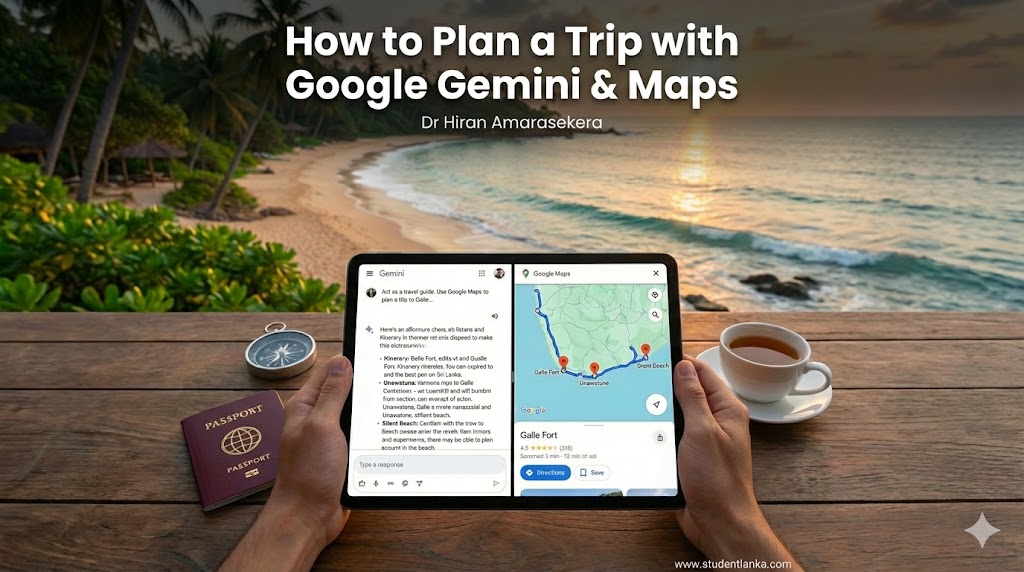
Planning a holiday in Sri Lanka used to be a research nightmare. You know the drill: one tab open for Booking.com, another for Google Maps to check distances, a third for TripAdvisor reviews, and a fourth for a travel blog to find “hidden gems.”
That era is over.
As we discussed in our latest video analysis, the Google Gemini + Google Maps integration has fundamentally changed how we access information. It bridges the gap between Generative AI (creative ideas) and Geospatial Data (real-world facts).
Here is how you can use this tool to build a data-backed itinerary for Galle, Tangalle, or anywhere in the island—in seconds.
The Upgrade: Old Way vs. The Gemini Way
| Feature | The Old Way (Traditional Search) | The New Way (Gemini + Maps) |
| Workflow | Manually switching between 5-10 browser tabs. | Single chat interface. |
| Data Verification | You must check if a place is actually open or exists. | Auto-verified: Gemini checks real-time Map data. |
| Routing | Guessing travel times between locations. | Precise: Calculates routes based on actual traffic data. |
| Personalization | Generic blog lists (“Top 10 places in Galle”). | Custom plans based on your specific constraints. |
The Secret Formula: “Act as” + “Use Google Maps”
Most students and professionals use AI like a search engine—asking simple questions. To get a “Knowledge Graph” level response, you need to use prompt engineering.
The Golden Prompt:
“Act as a travel guide. Use Google Maps to plan a [Number of Days] trip to [Location], focusing on [Interests].”
Why this specific phrasing matters:
- “Act as a travel guide”: This instructs the AI to adopt a specific persona, ensuring the tone is curated and professional rather than robotic.
- “Use Google Maps”: This is the trigger command. It forces Gemini to stop “guessing” (hallucinating) and start “looking” at its real-time database of locations, opening hours, and distances.
Real-World Example: The Southern Coast Itinerary
Let’s look at the exact output we generated for a 2-day trip to the South.
Input Prompt:
“Act as a travel guide. Use Google Maps to plan a two-day itinerary to Galle and Tangalle with beach places, whale and coral watching.”
The Data-Backed Output:
Day 1: Heritage & Corals (Galle & Hikkaduwa)
- Morning (Coral Gardens): The AI identified Hikkaduwa as the optimal start point. It suggested hiring a glass-bottom boat—a classic Sri Lankan experience—verifying that the location is effectively on the way to Galle.
- Afternoon (The Fort): It routed us to the Galle Dutch Fort. Instead of just saying “visit the fort,” it highlighted walking the ramparts and the lighthouse, knowing these are the high-rated visual landmarks.
- Evening (Sunset): It suggested Jungle Beach or Unawatuna, correctly identifying them as prime sunset spots nearby.
Day 2: Giants & Hidden Gems (Mirissa & Tangalle)
- 06:00 AM (The Logistics): Gemini knows that whale watching at Mirissa Fishery Harbour requires an early start. A standard chatbot might miss this crucial timing detail.
- Afternoon (The “Hidden Gem”): This is where the Maps integration shines. It suggested Silent Beach (Amanwella) and Goyambokka Beach.
- Note: Silent Beach is often missed by standard searches, but Gemini found it via high-rating clusters on Maps.
- Evening (Nature): A visit to Paravi Wella, a natural rock pool in Tangalle that is safe for bathing—a critical safety detail for families.
Why This Matters for Sri Lankan Students & Pros
This isn’t just about holidays; it’s about Information Literacy.
In the past, “being smart” meant memorizing facts. Today, it means knowing how to retrieve and synthesize facts using the right tools. Whether you are planning a class trip, researching for a Geography assignment, or organizing a family pilgrimage to Anuradhapura, the ability to command AI to cross-reference data is a Tier-1 skill.
Next Steps
Try it yourself. Open Google Gemini on your phone today. Copy the “Golden Prompt” above, change the location to “Kandy and Nuwara Eliya,” and see if it can build you the perfect up-country weekend.
Part of our “Digital Mastery & Productivity” Series | By Dr. Hiran Amarasekera



Leave a Reply